
Choosing the correct headform for RPE testing is not always as straightforward as it first appears. Some standards clearly define the headform to use. Others refer to a separate test method. Some do not give much detail at all.
The short answer is this:
For formal RPE testing, use the headform specified by the standard or test method.
For many EN respiratory protective equipment standards, that will usually mean the Sheffield head. Increasingly, however, ISO test methods are being referenced, and in those cases the correct headform may be one of the five ISO 16900-5 RPD headforms.
Where no specific headform is stated, the choice should be based on the purpose of the test. As a practical rule of thumb, the Sheffield head is often the safest default for EN-style RPE testing. For some development, demonstration or fixture checks, a generic headform may be all that is needed.
Why the headform matters
A headform is not just a convenient way to hold a mask in place. In many RPE tests, it forms part of the test setup.
The headform can affect:
- how the mask or facepiece sits on the face;
- the internal dead space around the nose and mouth;
- breathing resistance measurements;
- CO₂ content of inhalation air;
- the position of sampling tubes;
- the repeatability of the test.
This is why standards often define not only the headform, but also the breathing connection, mouth opening, sampling arrangement and how the product should be mounted.
Changing the headform can change the result, especially where the test depends on facepiece geometry, breathing flow or dead space.
The Sheffield head 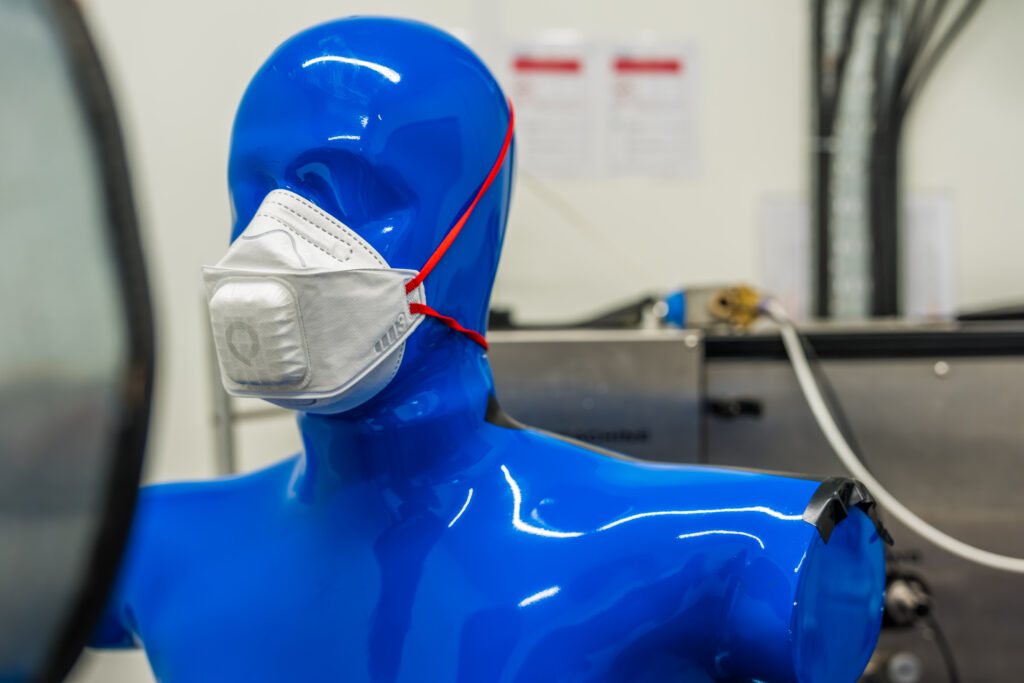
The Sheffield head, sometimes called the Sheffield dummy head, is one of the most widely recognised headforms in EN RPE testing.
It has a long history in UK and European respiratory protection test methods and is commonly used for tests involving simulated breathing, CO₂, breathing resistance and mounting of facepieces.
The Sheffield head appears to have originated from UK Health and Safety Executive respiratory protection test work. It became established as a repeatable laboratory fixture and was later carried into British and European RPE standards.
That history is important. The Sheffield head was not designed to represent every possible human face. Its main purpose is repeatability. It gives laboratories a consistent way to mount RPE, connect it to a breathing machine and compare results.
In other words, the Sheffield head is a standard test fixture. It is not a substitute for wearer face-fit testing.
When should you use the Sheffield head?
Use the Sheffield head whenever the standard or referenced test method requires it.
This is common in EN RPE testing, particularly for methods involving:
- CO₂ content of inhalation air;
- breathing resistance;
- simulated breathing;
- filtering half masks;
- half masks and full face masks;
- hoods, helmets and powered RPE systems.
If you are testing to an EN RPE standard and the method refers to a Sheffield head or Sheffield head/torso, that is the headform you should use.
If the standard does not clearly state a headform, but the method follows established EN RPE test practice, the Sheffield head is usually the most defensible default.
When should you use ISO headforms?
ISO RPD standards increasingly call up ISO test methods and equipment. In these cases, the correct headform may be defined by the ISO 16900 series.
ISO 16900-5 includes five RPD headform categories:
- small;
- short/wide;
- medium;
- long/narrow;
- large.
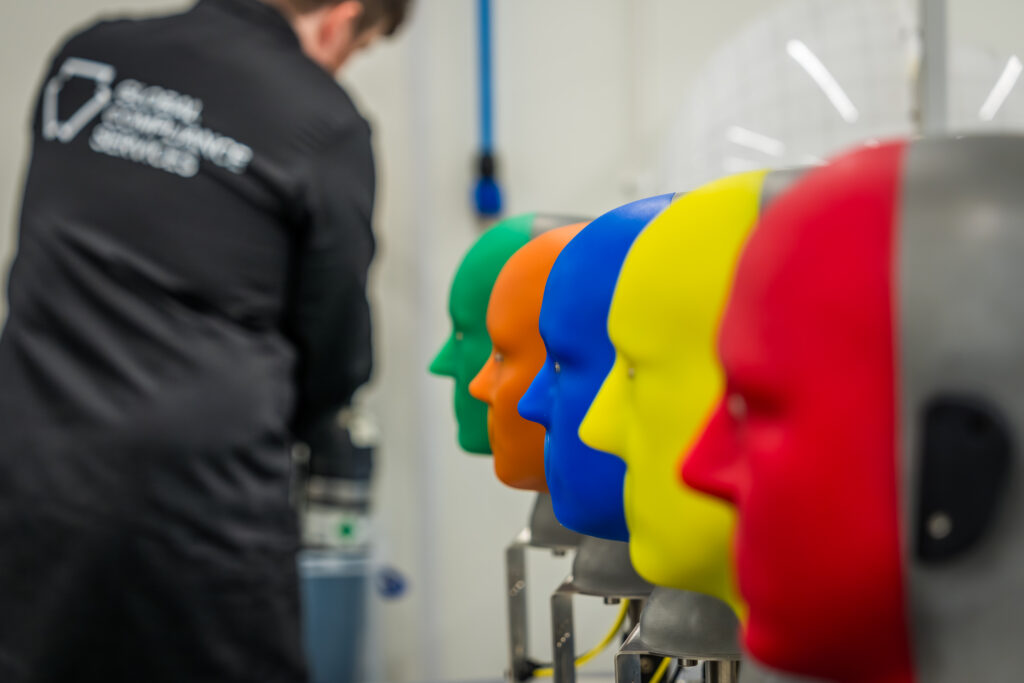
These headforms provide a broader range of facial size and shape categories than a single standard headform.
Use ISO headforms when:
- the standard calls up an ISO test method;
- the method specifically refers to ISO 16900-5 headforms;
- a particular headform size is required;
- the test is intended to assess performance across different head sizes or facial shapes;
- the customer or certification route specifies ISO headforms.
The key point is not to choose between Sheffield and ISO based on preference. The standard decides.
What if the standard does not specify a headform?
Some standards or customer specifications do not clearly state which headform to use. In that case, the best approach is to consider the purpose of the test.
If the result depends on how the product sits on the face, how it seals, how air flows through it or how much dead space exists around the mouth and nose, the headform matters.
For EN-style RPE testing, the Sheffield head is usually a sensible default because it is widely recognised and commonly used in established test methods.
However, if the headform is only being used to support the product for a non-critical check, a generic headform may be sufficient. This might apply to early development work, visual assessments, demonstrations, fixture trials or simple airflow checks where formal compliance is not being claimed.
The important thing is to be clear. If a generic headform is used, the result should not be presented as equivalent to a formal EN or ISO test unless the required standard equipment has been used.
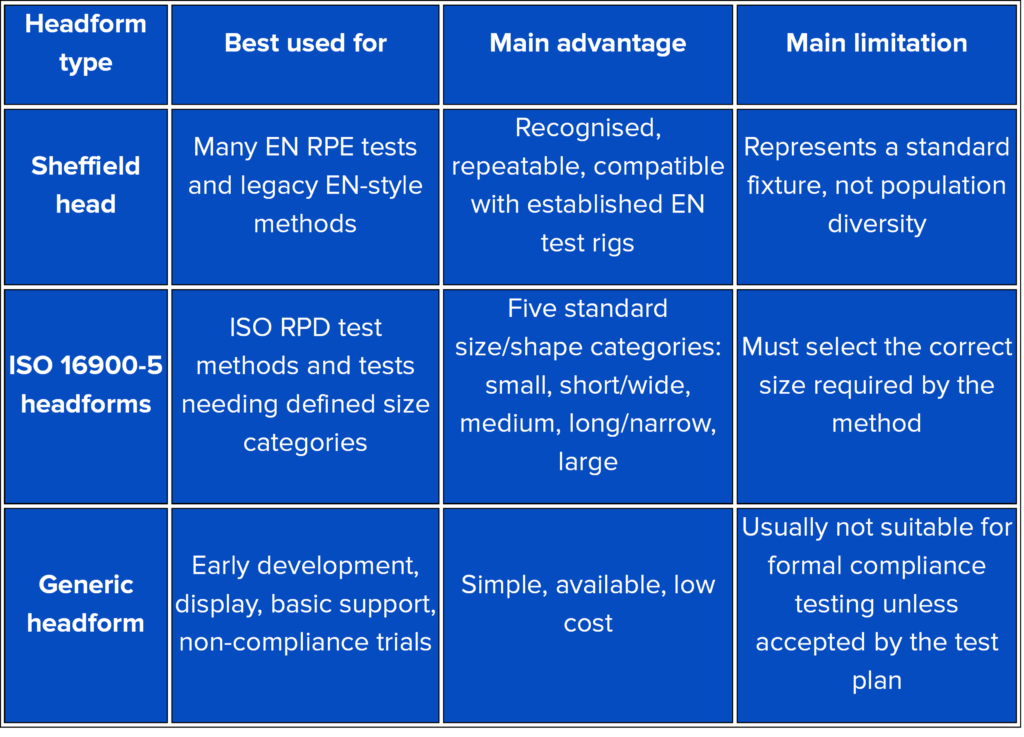
Headform comparison
Practical rule of thumb
For formal RPE testing: Use the headform specified by the standard.
If the standard calls for the Sheffield head, use the Sheffield head.
If the standard calls for ISO 16900-5, use the correct ISO headform size.
If the standard does not specify a headform, use the one that best matches the test objective and document your reasoning. For EN-style RPE testing, the Sheffield head is usually the safest default. For non-critical development or support-only applications, a generic headform may be enough.
Conclusion
The best headform for RPE testing is not always the most realistic-looking one. It is the one required by the test method.
For many EN respiratory protective equipment tests, that will be the Sheffield head. For ISO-based methods, it may be one of the five ISO 16900-5 RPD headforms. Where no specific headform is stated, the decision should be based on the test objective, with the Sheffield head often acting as the best default for EN-style testing.
A headform is part of the test method. Choosing the right one helps make RPE test results consistent, meaningful and defensible. If you have any questions, why not get in touch with one of our team.