
Can PPE be CE marked without meeting a harmonised EN standard in full? Yes, provided the manufacturer demonstrates compliance with every applicable essential health and safety requirement of Regulation (EU) 2016/425 and completes the required conformity assessment. A technical specification can provide the basis for that demonstration.
This guide explains the approach for PPE placed on the EU market, including what it means for testing, certification, product marking and marketing claims.
What is the technical specification route
A technical specification sets out technical requirements that the PPE must meet. It may use a non-harmonised standard, selected clauses from existing standards, or a product-specific document defining requirements, test methods and acceptance criteria. The term does not refer only to documents formally published as CEN Technical Specifications.
The “technical specification route” describes using these alternatives wholly or partly. It is not a separate conformity assessment module. The specification defines requirements; the technical file contains the design information and evidence demonstrating compliance.
How it differs from using harmonised standards
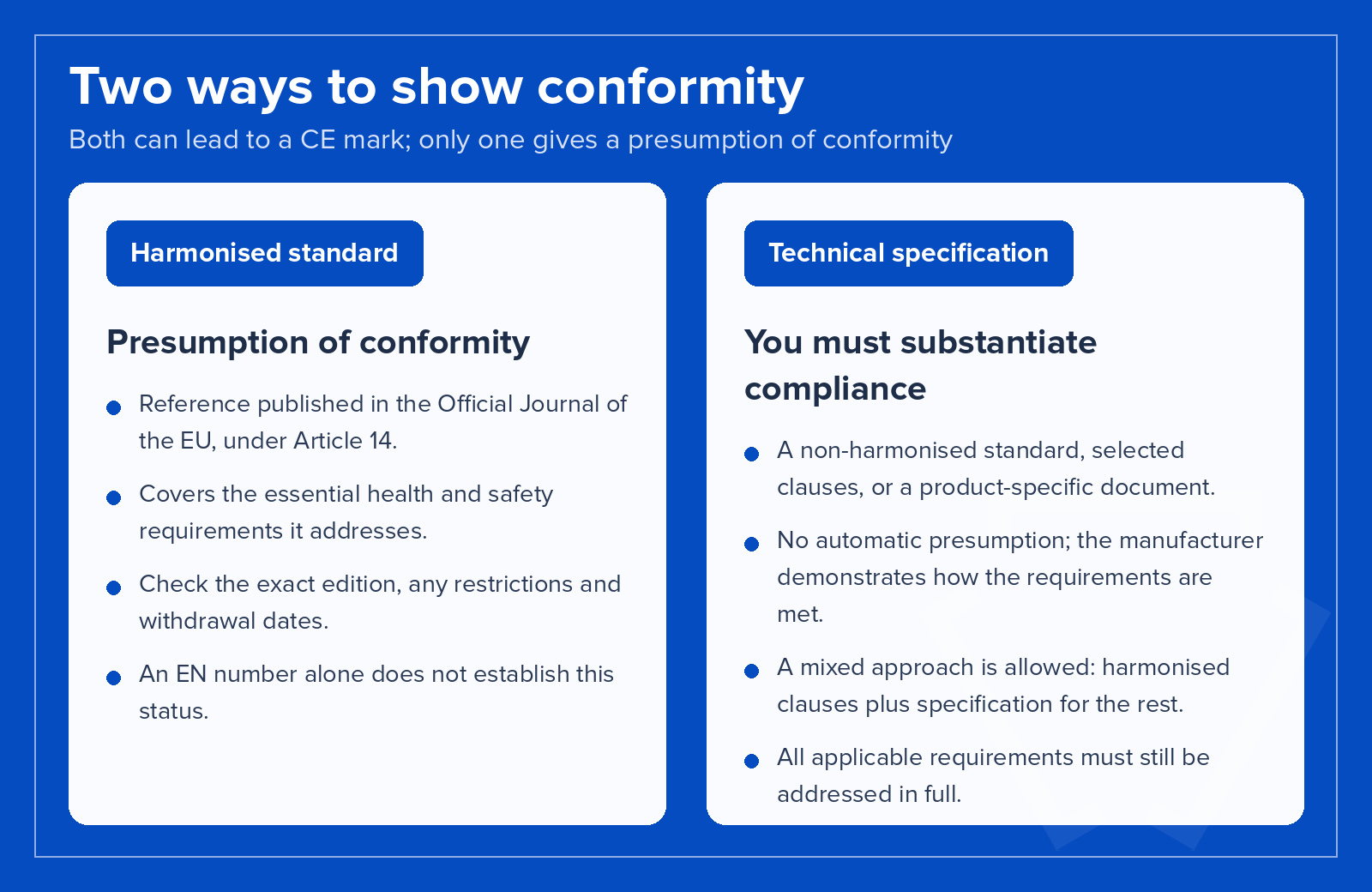
Under Article 14, conformity with an applicable harmonised standard, or parts of it, whose reference is published in the Official Journal of the EU gives a presumption of conformity with the essential health and safety requirements it covers. Check the precise edition, any restrictions and applicable withdrawal dates. An EN number alone does not establish this status.
Other technical specifications do not provide that presumption. The manufacturer must substantiate how the alternative approach satisfies the relevant legal requirements. A mixed approach is possible: use harmonised clauses where suitable and technical specifications for the remaining requirements. All applicable requirements must still be addressed.
When this approach can be useful
It can be appropriate where no suitable harmonised standard exists, a new design falls outside an existing standard’s scope, or a standard does not adequately address a product’s intended protection. A newer standard awaiting Official Journal citation may also provide useful technical evidence.
A failed standard test does not, by itself, justify changing the requirement. Any departure needs a defensible technical basis showing compliance with the relevant essential health and safety requirements, taking account of the state of the art.
What manufacturers need to do
For Category II and III PPE, discuss the proposed basis with a suitably scoped Notified Body before commissioning tests.
Build a specification that can be assessed
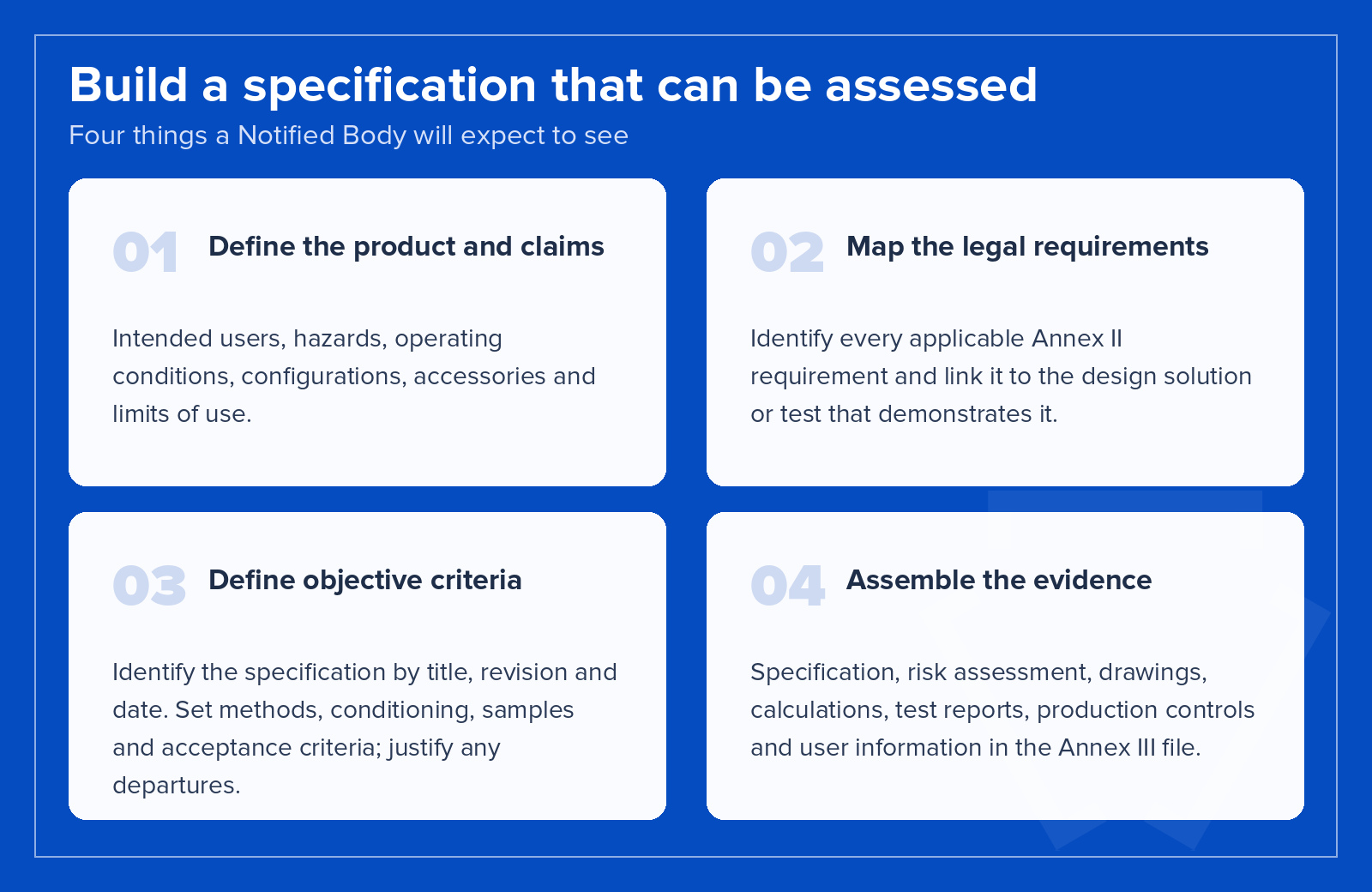
- Define the product and claims. Specify intended users, hazards, operating conditions, configurations, accessories and limits of use.
- Map the legal requirements. Identify every applicable Annex II requirement and link it to the design solution, examination or test that demonstrates compliance.
- Define objective criteria. Identify the specification by title, revision and date. Specify methods, conditioning, samples and acceptance criteria; explain departures from relevant standards and justify alternative methods.
- Assemble the evidence. Include the specification, risk assessment, drawings, calculations, test reports, production controls and user information in the Annex III technical documentation. Identify any harmonised clauses applied only in part.
For EU type-examination, the Notified Body assesses the technical documentation and specimens representative of the envisaged production, checking whether the alternative solutions satisfy the corresponding legal requirements. A test report alone does not complete certification.
The certification procedure stays the same
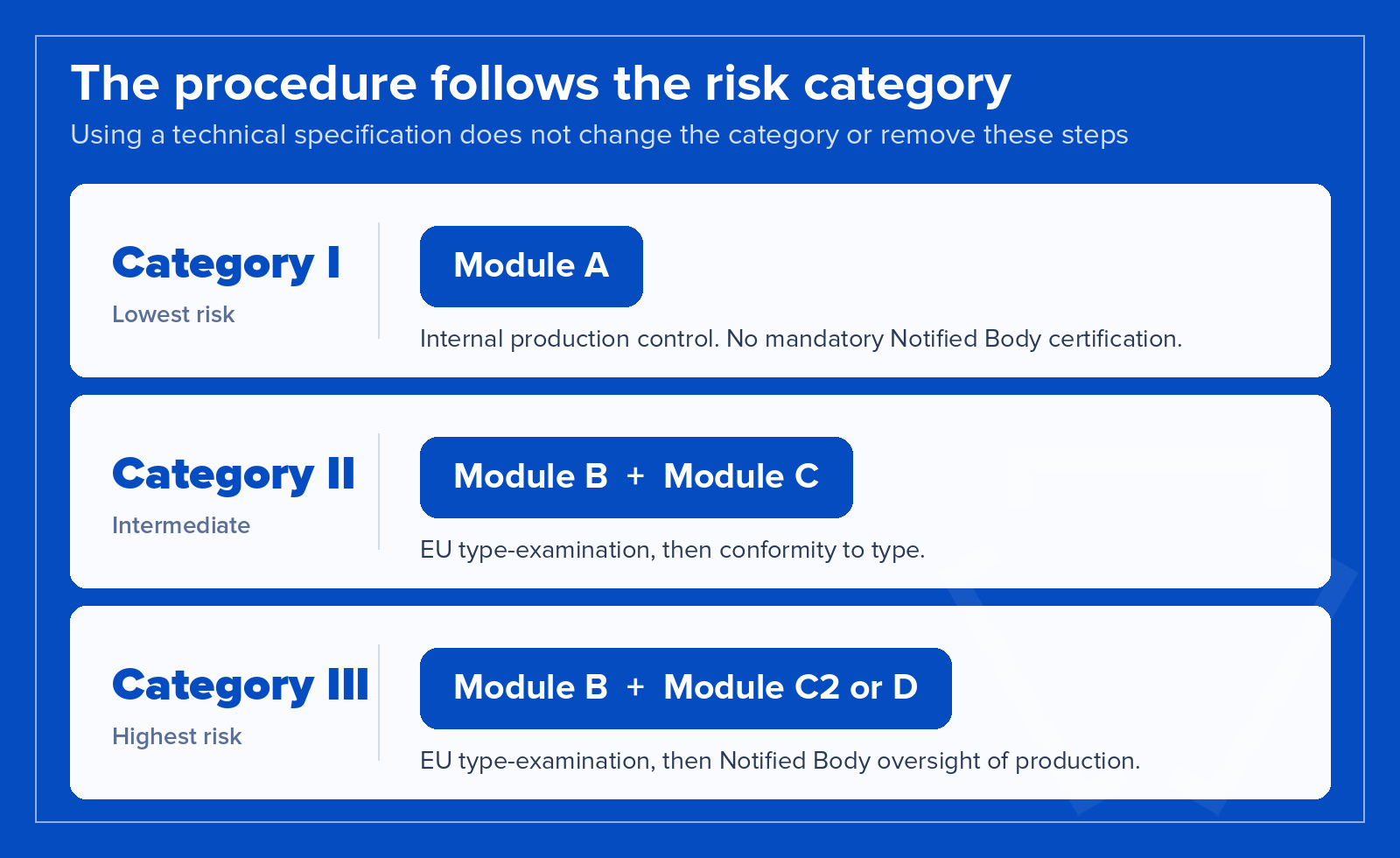
The category of risk determines the procedure: Category I uses Module A, without mandatory Notified Body certification; Category II requires Module B EU type-examination followed by Module C; Category III requires Module B followed by Module C2 or Module D with Notified Body oversight. Using a technical specification does not change the category or remove these obligations.
The Module B certificate identifies the technical specifications and any harmonised standards or parts applied, plus relevant performance levels, classes and conditions.
What can you mark and claim
CE marking remains available once all applicable legal requirements and conformity assessment steps are fulfilled. There is no separate CE mark for this approach. For Category III, the number following CE identifies the Notified Body responsible for Module C2 or D, which may differ from the body issuing the Module B certificate.
The EU declaration of conformity must reference the actual standards and/or other technical specifications used, including their dates. The instructions must also identify the relevant assessment references and explain performance, markings and limits of use. Required identification and traceability information still applies.
Keep labels, instructions, datasheets and website claims consistent with the certified scope. Using selected EN test methods does not establish full conformity with that EN standard. Avoid wording or markings that imply full conformity, or a standard-defined class, unless the assessment supports that claim.
For example, where accurate: “EU type-examined under Regulation (EU) 2016/425 using Technical Specification ABC, revision 2, dated [date].” Agree proposed markings and classification wording with the Notified Body.
Certification against a technical specification can support lawful EU market access, but purchasers may separately require conformity with a named EN standard. Check tender and customer requirements before choosing the approach.
Maintain production conformity and review changes to the product, specification and state of the art. Notify the certifying body of changes affecting conformity or certificate validity; additional approval may be required. EU type-examination certificates are valid for no more than five years.
Developing an RPE product that does not fit neatly within an existing standard? Speak to GCS about testing requirements and evidence planning, alongside early discussion with your chosen Notified Body.
Sources
- Regulation (EU) 2016/425. Relevant provisions: Articles 3(9), 8, 14, 15, 17 and 19; Annex II points 1.4 and 2.12; Annex III; Annex V points 2, 4, 6 and 7; Annex IX. The Commission guidelines reproduce and explain the provisions consulted. View on EUR-Lex.
- European Commission PPE Regulation Guidelines, fifth edition, October 2025. In particular sections 2.3 and 4.1 on technical specifications and voluntary use of harmonised standards. Guidance assists interpretation; the Regulation is the legal authority. View on the European Commission site.
- European Commission harmonised standards page. Use the current Official Journal decisions to verify a particular standard edition’s status, restrictions and withdrawal dates. View the harmonised standards page.