
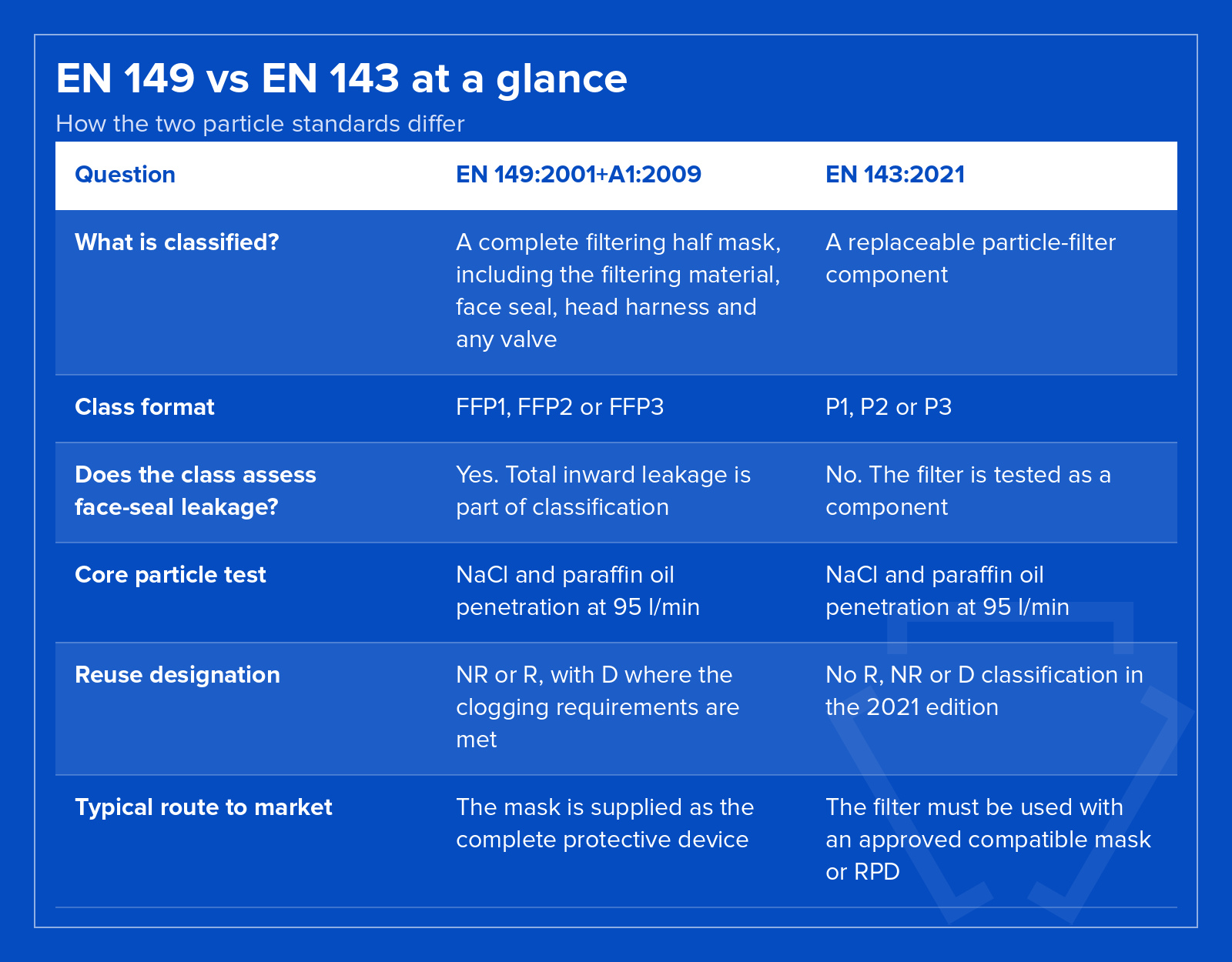
FFP2 and P2 look similar, but they do not describe the same product or the same evidence. EN 149 classifies a complete particle filtering half mask. EN 143 classifies a replaceable particle filter that must be fitted to a compatible respiratory interface.
Both standards use sodium chloride and paraffin oil aerosols at 95 l/min for filter penetration, and the P1/P2 limits happen to match the FFP1/FFP2 limits. That does not make the classifications interchangeable. The product boundary, leakage assessment, conditioning, breathing-resistance limits and marking rules are different.
For a manufacturer or new entrant, the first decision is therefore not which number to claim. It is which product is being placed on the market.
The basic distinction
What FFP1, FFP2 and FFP3 mean under EN 149
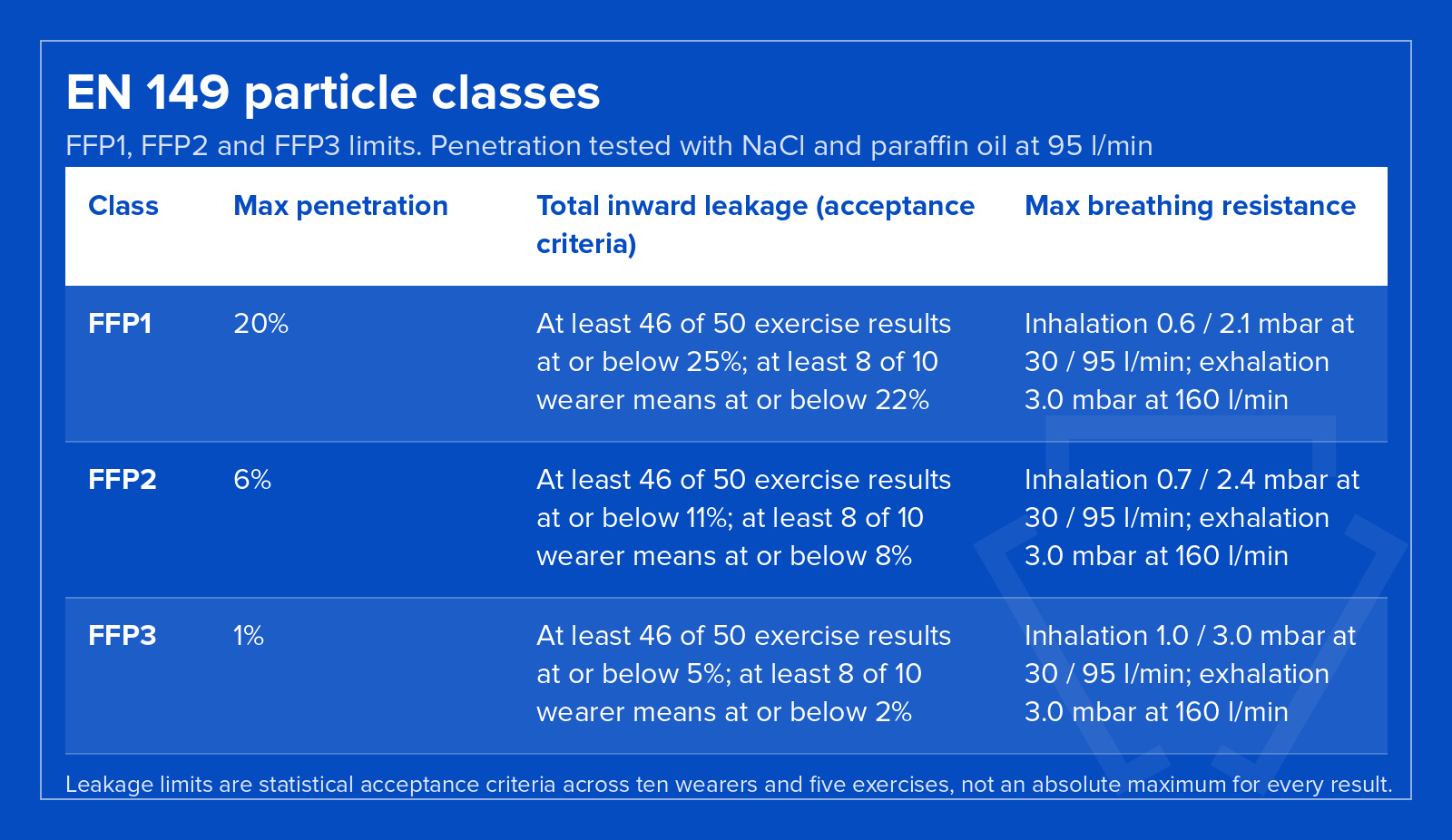
EN 149 combines three different aspects of performance: penetration through the filter material, total inward leakage of the complete mask on wearers, and breathing resistance. A product does not become FFP2 or FFP3 by passing the penetration test alone.
The leakage limits are statistical acceptance criteria. EN 149 uses ten test subjects and five exercises per subject, creating 50 exercise results, plus a mean for each wearer. It is therefore misleading to label 25%, 11% or 5% as an absolute maximum for every individual result. The standard expressly permits the stated statistical pattern.
Filter penetration is tested separately. Nine masks are required for each aerosol: three as received, three after simulated wearing, and three after mechanical strength and temperature conditioning. For reusable products, the last group also receives a cleaning and disinfection cycle and the EN 13274-7 exposure and storage route specified by EN 149.
NR, R and D are separate design decisions
- NR means the mask is limited to a single shift. The dolomite clogging test is optional.
- R means the mask is designed for more than one shift. Cleaning and disinfection, storage and post-treatment performance need to be designed and validated. The clogging test is mandatory for this route.
- D means the mask has met the dolomite clogging requirements. After dust loading, the product must remain within the applicable post-clogging resistance limits and still meet its filter-penetration requirement.
An R product is not an NR product with different artwork. The cleaning method, number and nature of reuse cycles, materials, straps, valve performance and storage process should be settled early enough to be represented by the tested samples and the manufacturer’s instructions.
An exhalation valve is optional, but it creates additional requirements. The valve must function after conditioning, resist dirt or mechanical damage, continue to operate after the specified continuous-flow conditioning and, where the housing is attached to the faceblank, withstand the attachment-strength test. A valve does not relax the leakage or breathing-resistance limits for the claimed FFP class.
What P1, P2 and P3 mean under EN 143
EN 143 classifies the replaceable filter according to filtering efficiency. It does not test the seal between a mask and a wearer. Protection provided by the assembled respirator depends on the filter, its connection and the performance of the compatible facepiece or powered device.
Three filters are tested for each aerosol after temperature conditioning followed by mechanical-strength conditioning. The temperature cycle is 24 hours in a dry atmosphere at 70 °C and 24 hours at -30 °C, with controlled transitions and recovery. The mechanical treatment uses 2,000 rotations of the standard conditioning apparatus.
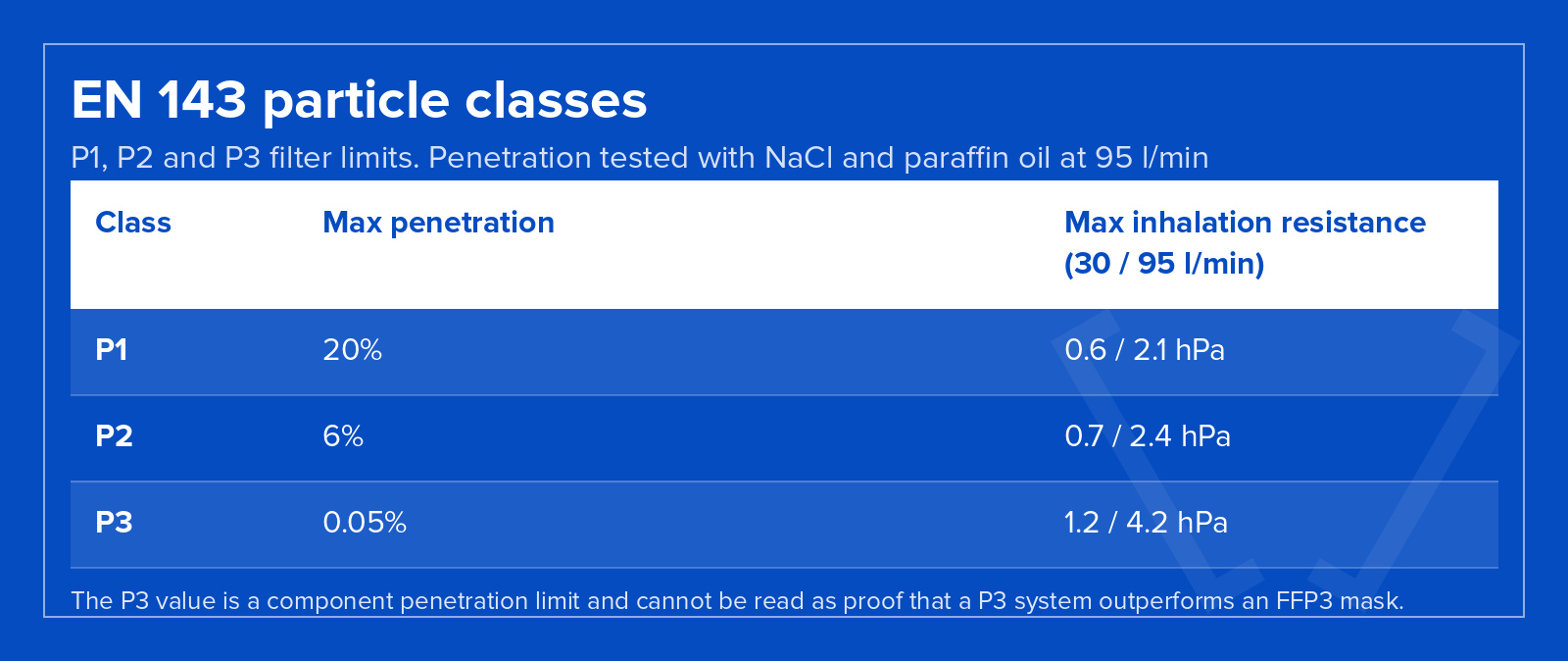
The particularly low P3 penetration limit is sometimes used to imply that a P3 system must always outperform an FFP3 mask. That conclusion cannot be taken from these figures. The 0.05% value is a component penetration limit. EN 149’s 1% value sits within a complete-device standard that also assesses total inward leakage on people. Whole-device protection can only be understood from the applicable complete-RPD standard and the approved combination.
Configuration requirements that often change the EN 143 test plan
Twin or multiple filters. Where airflow is shared between filters, the complete set has to meet the standard. A single filter can normally be tested at its apportioned flow only if the resistance balance supports that approach. If one filter is also intended for use alone, it must meet the requirements at the full test flow. The marking and instructions need to prevent the user from confusing those configurations.
Filter mass. Filters connected directly to a half mask are limited to a combined maximum of 300 g. Filters connected directly to a full face mask are limited to 500 g. A filter set above the half-mask limit must carry the specified full-face-mask-only limitation.
Connection and interchangeability. The connection must be robust and leaktight, incorrect assembly must be prevented, and the manufacturer must support this with the required risk-assessment declaration. A filter for a twin or multiple-filter facepiece, or one using another thread, must not be connectable to an EN 148-1 thread.
Current marking conventions. EN 143:2021 uses P1, P2 or P3. The previous clogging route was deleted, and the current edition does not use the EN 149 R, NR and D classification suffixes. Legacy artwork should not be carried forward without checking it against the 2021 edition.
A practical decision rule for manufacturers
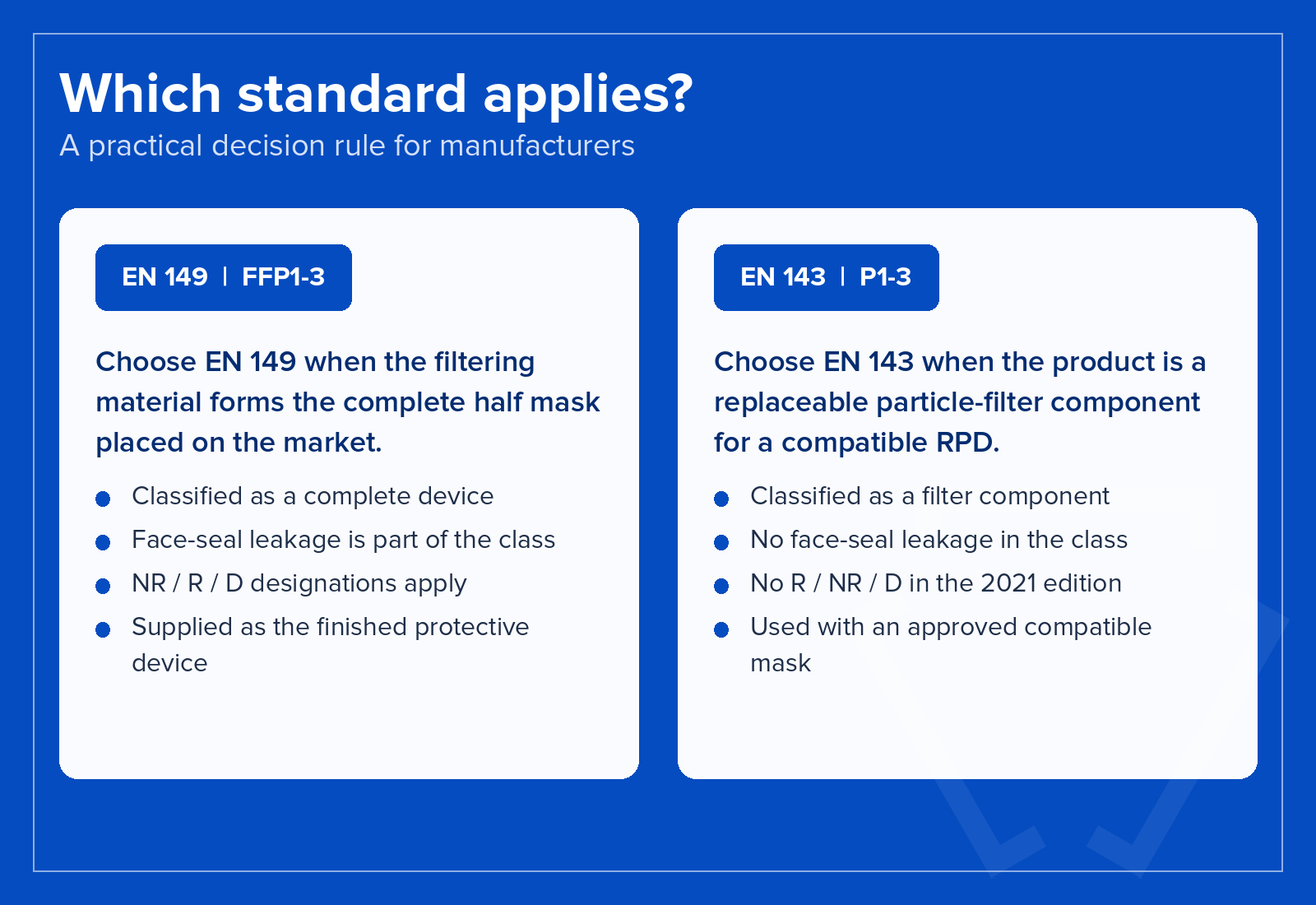
Choose EN 149 when the filtering material forms the complete half mask placed on the market. Choose EN 143 when the product is a replaceable particle-filter component for a compatible RPD.
Before agreeing samples or artwork, freeze the intended class, NR or R status, valve option, cleaning process, filter connection, permitted mask models, single or twin-filter arrangement, and whether a twin filter can ever be used alone. Those choices determine the conditioning, leakage, penetration, resistance, marking and instruction programme.
Planning filter testing? Get in touch with the GCS lab about choosing the right standard and samples, or email the team at laboratory@global-compliance-services.com.
Technical basis: EN 149:2001+A1:2009 and EN 143:2021. The standards can be purchased from BSI: EN 149 and EN 143.