
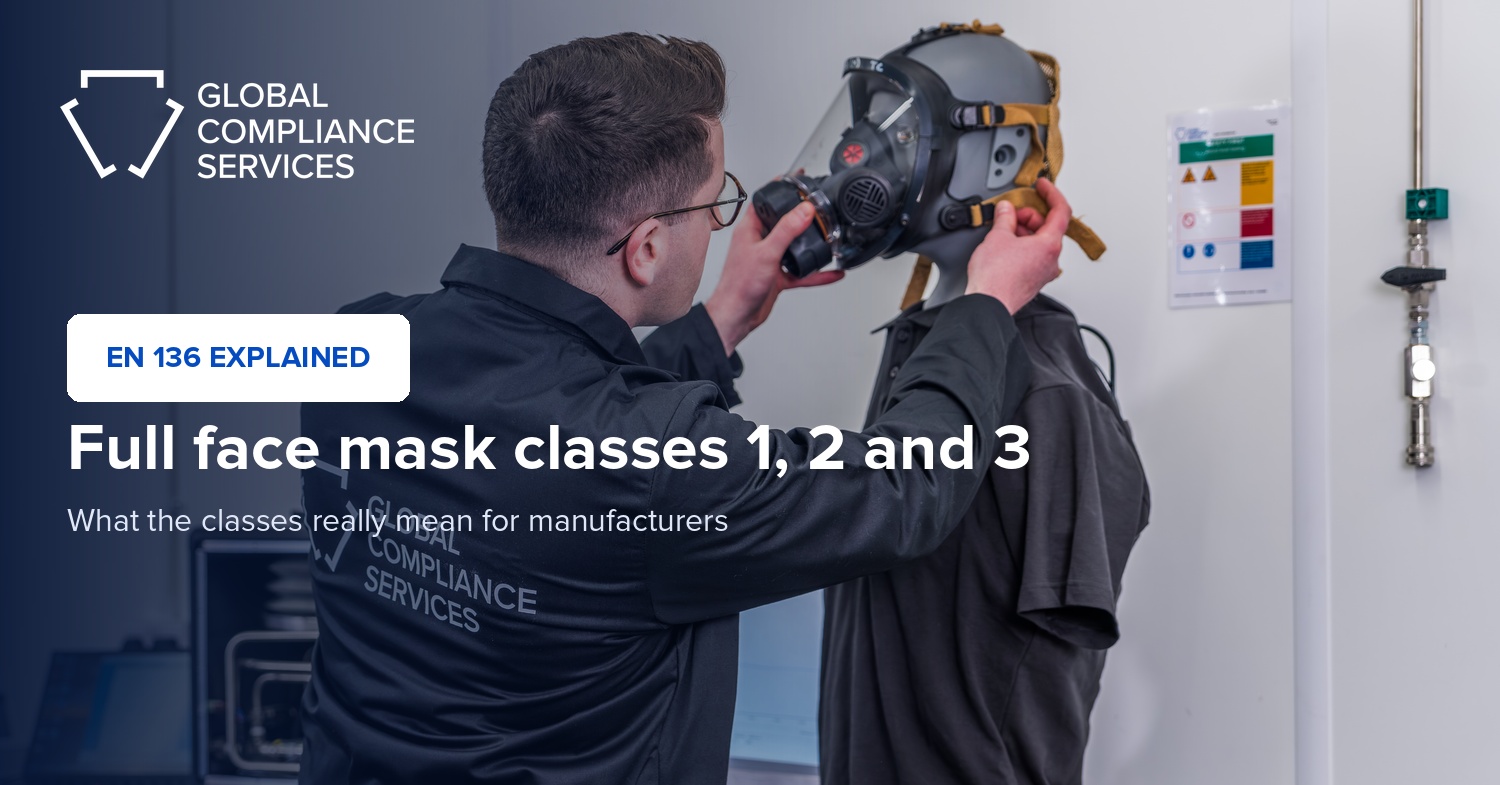
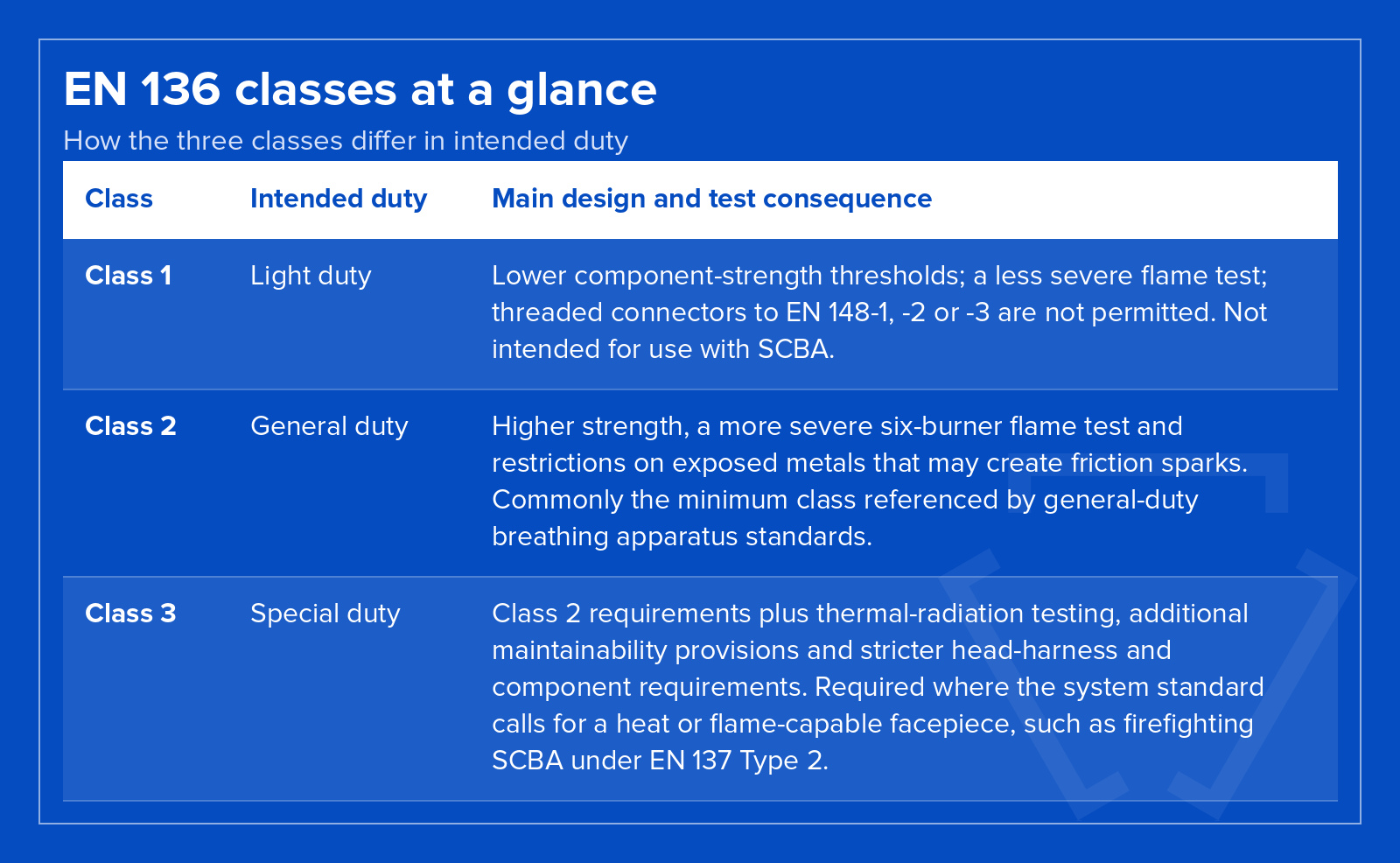
EN 136:1998 divides full face masks into three classes. The important point for manufacturers is that these are application and robustness classes, not three progressively higher respiratory protection factors. All three classes are subject to the same core face-seal leakage requirement, but the construction, strength, flame and heat requirements become more demanding as the intended duty increases.
EN 136 classes at a glance
What does not change between the classes?
Every EN 136 mask still needs to meet the core requirements for materials, cleaning and disinfection, practical performance, leakage, carbon dioxide, field of vision, breathing resistance, valves, speech transmission and marking. In the inward-leakage test, the leakage must not exceed 0.05% for any of the ten test subjects and specified exercises.
Therefore, if you want to claim Class 2 or Class 3, do not position the class number as a better face seal by itself. The system-level protection delivered in use depends on the complete respiratory protective device, its configuration and fit.
The requirements that change
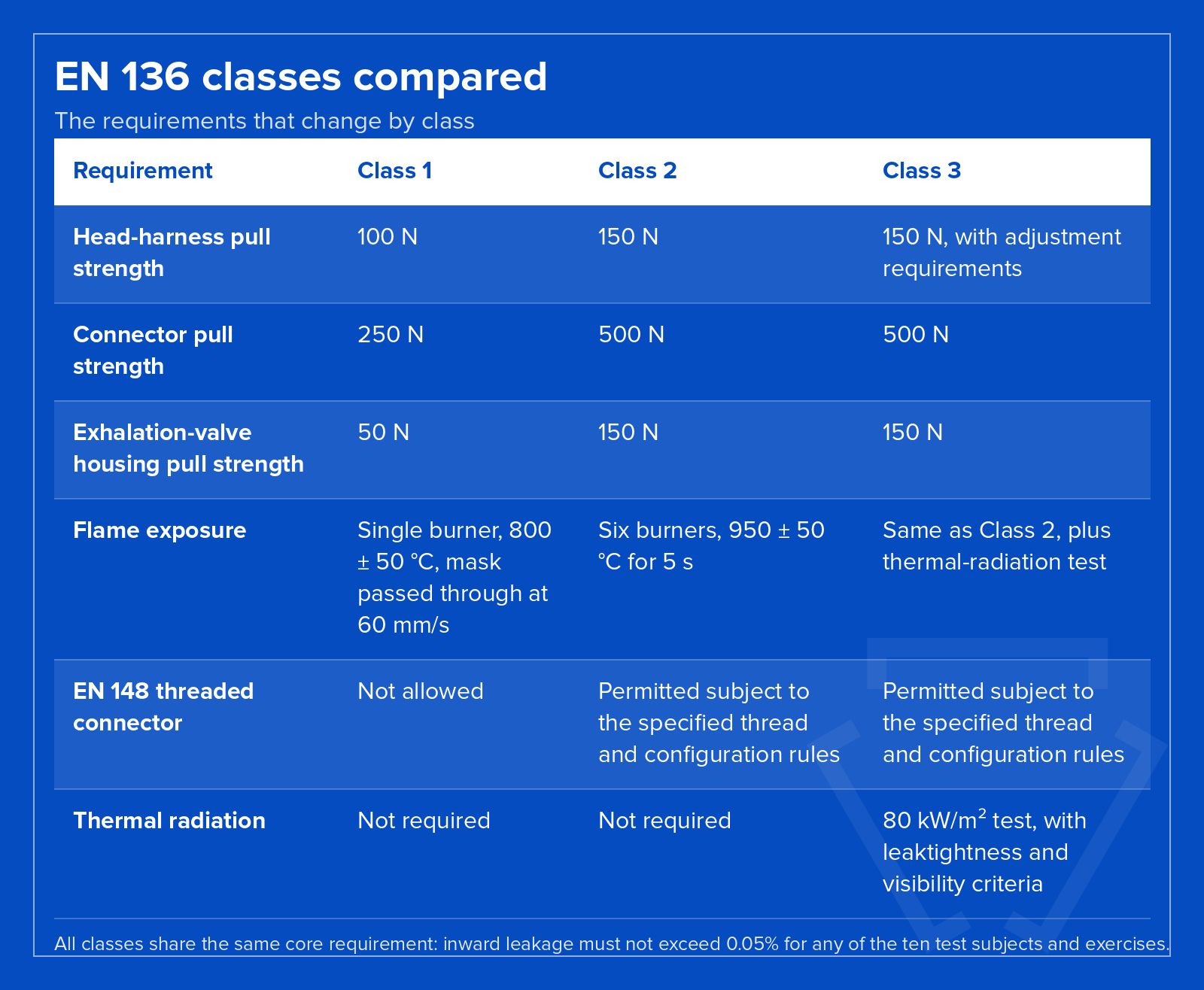
For Class 2 and Class 3, exposed aluminium, magnesium, titanium and alloys containing enough of these materials must not be used where impact or friction could generate an ignitable spark. For Class 3, the mask must also remain functional after severe radiant heat exposure. The standard assesses continued leaktightness and, where the visor begins to impair vision, how long usable vision is retained before a further leaktightness period.
Class 3 also has a stronger maintainability expectation. Specified items (including the inner mask, harness, visor, connectors, valves and speech diaphragm) must be replaceable unless they are designed as integral parts. The harness must be readily adjustable by the wearer or self-adjusting.
Optional and feature-triggered requirements
EN 136 does not have a separate optional performance clauses like some standards do. It does, however, contain several requirements that only apply when a feature or additional claim is included:
- Speech diaphragm: if incorporated, it must be protected against mechanical damage and withstand an 80 mbar differential pressure. If it can receive an external force, the assembly has a 150 N axial-strength test. On a Class 3 mask these requirements must still be met after thermal-radiation exposure.
- Valves, inner mask and lens wiper: their presence determines which functional, strength and maintenance provisions apply. For Class 3, the listed components must be replaceable unless integral.
- Additional non-respiratory protection: if the manufacturer claims visor impact protection, chemical protection or specialist protection for the speech diaphragm, the relevant additional PPE standard must also be met and the limitation or extra marking explained.
If you want to offer variants with and without these features, identify them as separate configurations in the design specification and test matrix. A test on the simplest facepiece should not automatically be assumed to cover a speech diaphragm, different valve layout or protective visor option.
What manufacturers should decide early
If the mask will only form part of a light-duty device, Class 1 may be sufficient, but its connector restrictions and exclusion from SCBA use need to be designed in from the start. If the mask is intended for demand-valve airline apparatus or industrial SCBA, check the equipment standard: it will normally drive you to at least Class 2. If firefighting, high-radiant-heat or another specialist application is in scope, Class 3 should be treated as a distinct thermal and maintainability design programme, not a late-stage extension of a Class 2 product.
The safest development approach is to define the intended complete device first, then trace its facepiece requirement back to EN 136. This avoids qualifying a mask class that cannot be used with the final breathing apparatus.
Planning EN 136 testing? Get in touch with the GCS lab about tracing your facepiece class back from the complete device, or email the team at laboratory@global-compliance-services.com.
Technical basis: EN 136:1998. The full standard can be purchased from BSI. Global Compliance Services (GCS) Ltd, UKAS accredited testing (ISO/IEC 17025, No. 8856).