
EN 12941:2023 and EN 12942:2023 classify two different types of powered air-purifying respirator (PAPR). EN 12941 uses a loose-fitting respiratory interface and the prefix TH; EN 12942 uses a tight-fitting mask and the prefix TM. The two class scales are not numerically equivalent.
The main class limits
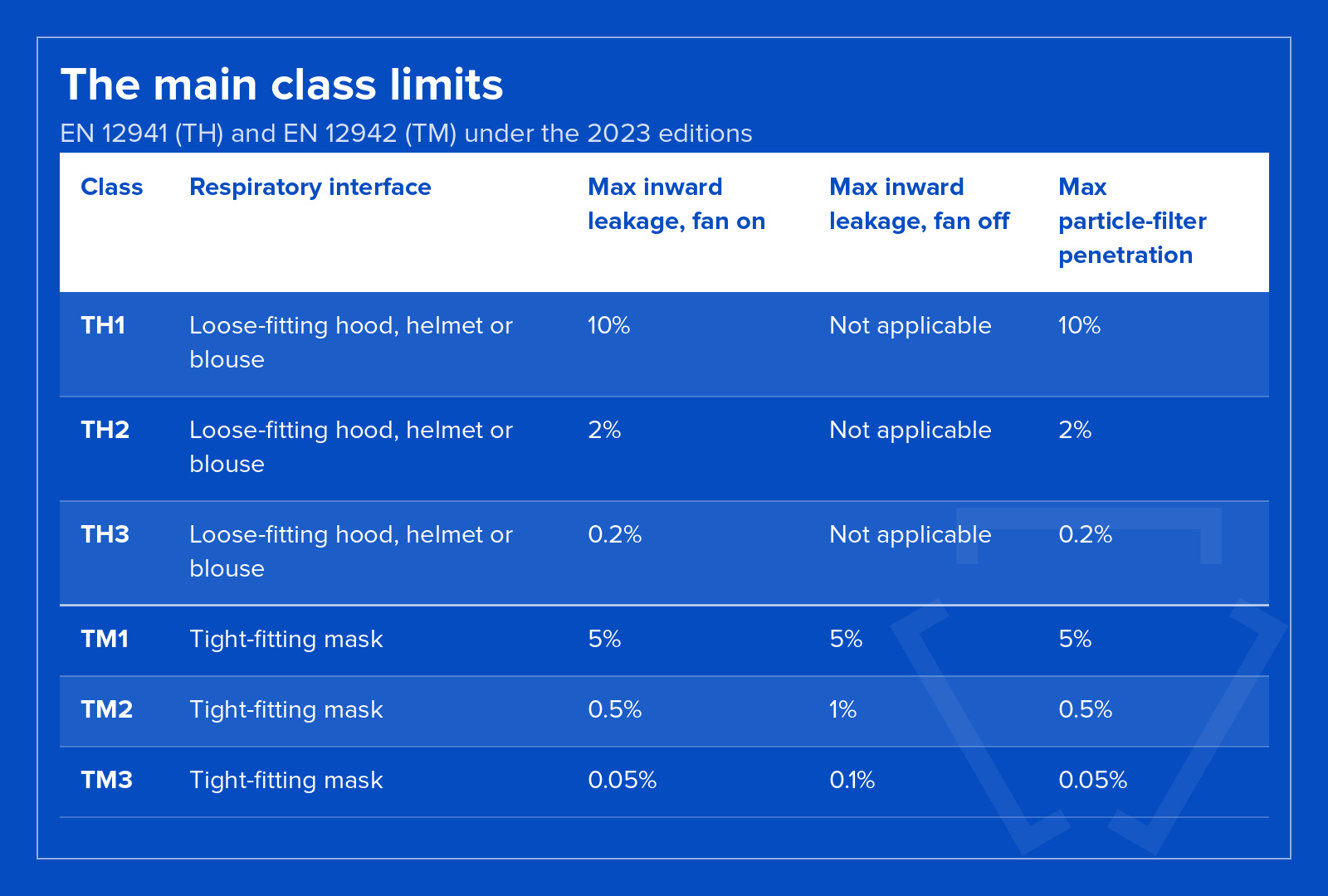
For particle and combined devices, the classification uses total inward leakage; for gas-filter-only devices, it uses inward leakage. The particle limits shown are the standard powered-device filter classes. Special mercury and nitrogen-oxide filters have separate penetration requirements.
The fan-off test in EN 12942 reflects the behaviour of a tight-fitting mask if powered flow is lost. There is no equivalent fan-off class table for a loose-fitting TH interface. If you want a TM2 or TM3 claim, the mask fit, valve arrangement and unpowered breathing path therefore need to be considered alongside powered performance.
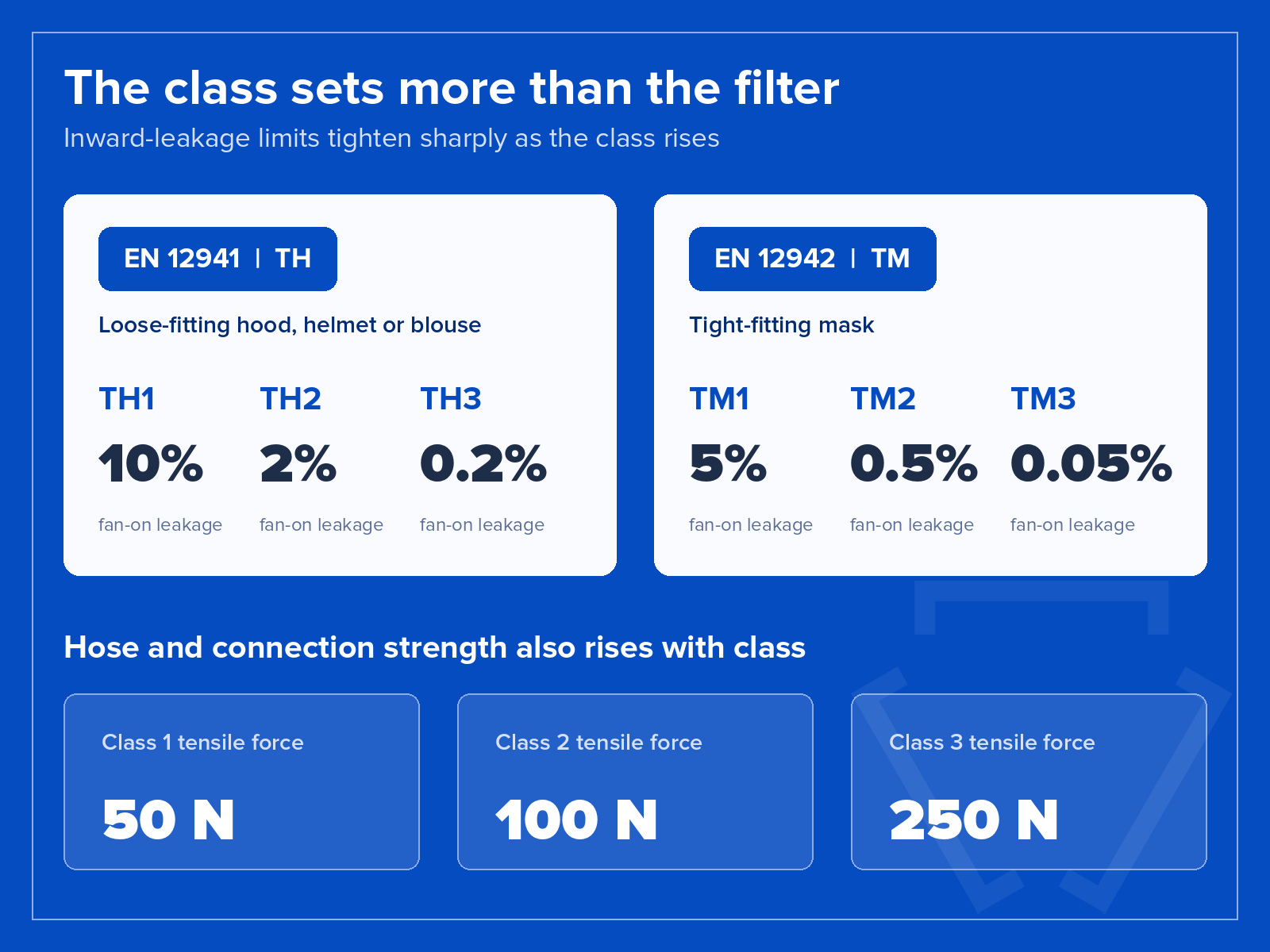
Class also changes component robustness
The class number is not only a filter efficiency figure. The breathing hose, coupling and connection system must withstand a tensile force of 50 N for Class 1, 100 N for Class 2 and 250 N for Class 3. Higher classification can therefore require a different hose, connector retention method or interface support, even where the blower and filter media are unchanged.
Both standards also cover practical performance, field of vision, breathing resistance or pressure, carbon dioxide, noise, temperature performance, mechanical strength, flammability, flow indicators, cleaning and marking. The 2023 editions require low-energy warnings across all classes and assess the device at the manufacturer’s declared minimum design condition.
If your design only warns at the point where flow is already inadequate, it will not meet the intent. Battery selection, control logic and alarm thresholds should be developed together so the warning provides a usable margin before minimum performance is lost.
Reading a full classification
A marking such as TH2A2P contains three separate decisions:
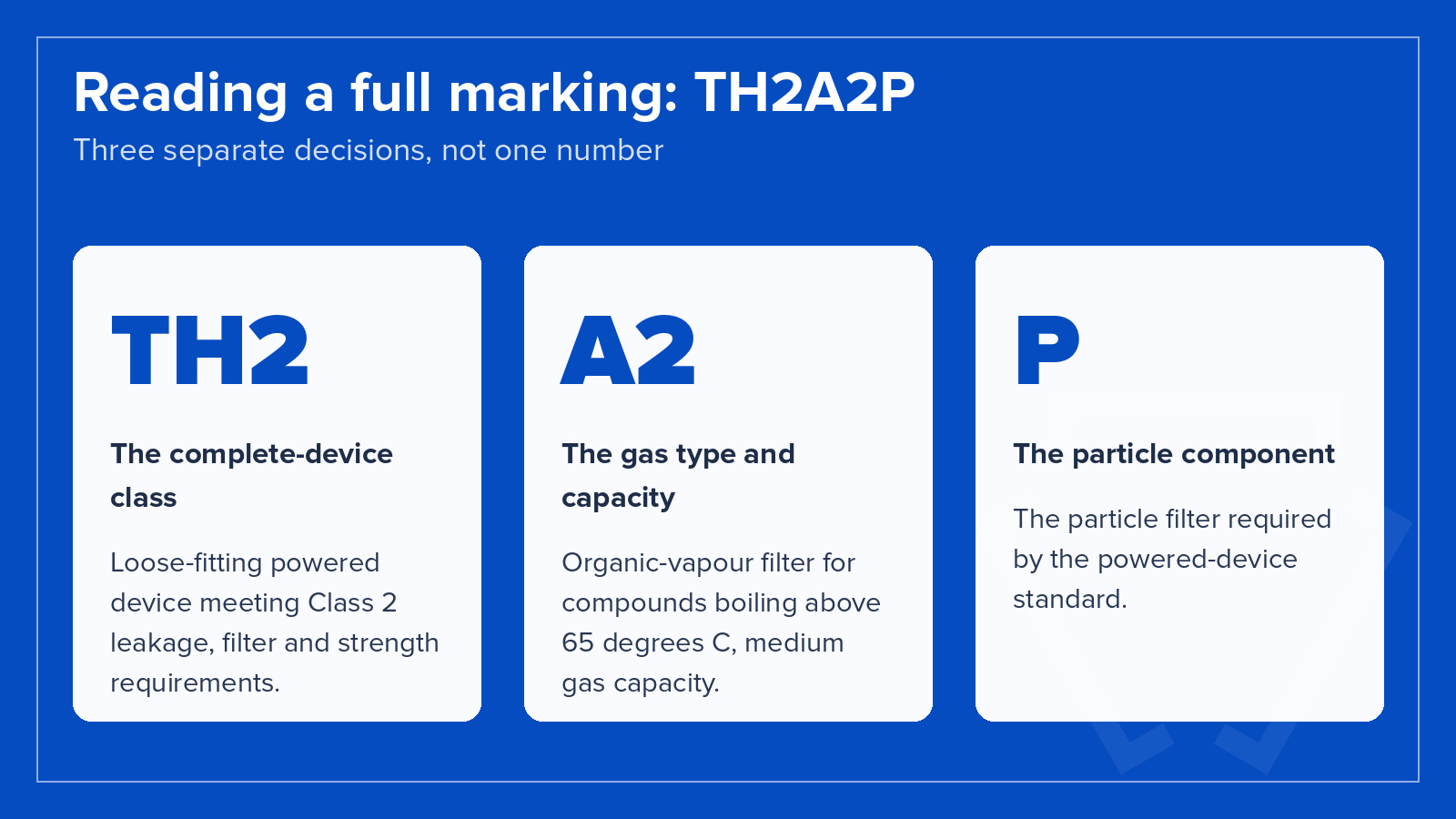
- TH2 identifies a loose-fitting powered device and its Class 2 leakage, filter and strength requirements.
- A2 identifies an organic-vapour filter for compounds boiling above 65 degrees C, with medium gas capacity.
- P identifies the particle component required by the powered-device standard.
The TH or TM class does not widen the gas range. A TH3 particle device does not become suitable for ammonia or solvent vapours unless the relevant gas-filter type and capacity have also been claimed and tested. Likewise, moving from A1 to A2 increases capacity testing; it does not change TH2 to TH3.
Optional claims and configuration triggers
The 2023 editions contain one explicitly optional test route and several manufacturer-choice triggers:
- MS mechanical-strength option: the blower unit and separate battery casing are conditioned, then mechanically stressed in three orientations with 650 rotations in each orientation. The conditioned device must still meet the specified leakage, breathing, airflow, warning, filter, noise, carbon-dioxide, flammability, mass and practical-performance requirements. A compliant product is marked MS.
- Potentially explosive atmospheres: if suitability or intrinsic safety is claimed, the RPD and its electrical components must meet the appropriate explosive-atmosphere requirements. If the product is not intended for such atmospheres, the information supplied by the manufacturer must make that clear.
- Additional PPE protection: a claim for head, eye, face or protective-clothing performance brings the relevant PPE standard into scope. The TH or TM approval does not substantiate that separate claim.
- Accessories: when an accessory is stated to be intended for use with the RPD, the complete RPD including that accessory must be tested. This can affect inward leakage, airflow, alarms, speech, field of vision and practical performance.
- Product configurations: alternative filters, batteries, hose lengths, flow settings and alarm settings must be assessed at the conditions that produce the minimum and maximum design performance. They should not be treated as paperwork-only variants.
If you want the MS marking or a broad accessory/configuration schedule, define it before sample selection. The optional route changes both conditioning and the downstream samples used for the main performance tests.
What manufacturers should lock down first
Start with the respiratory interface. A hood or helmet points to EN 12941; a tight-fitting half or full face mask points to EN 12942. Next set the target TH or TM class from the inward-leakage requirement, then define the filter types, minimum airflow, battery state and alarm strategy.
Do not assume a higher class can be achieved by changing filter media alone. At Class 3, facepiece/interface design, airflow control, fan-off performance for TM devices and 250 N hose/connection strength can all become limiting. Test the intended complete configuration (including filters, battery, blower, hose and interface) because the classification belongs to the assembled device.
Planning an EN 12941 or EN 12942 testing programme? Speak to the GCS lab about your interface, target class and configuration before you select samples.
Sources
- EN 12941:2023. Respiratory protective devices: powered filtering devices incorporating a loose-fitting respiratory interface. View on BSI Knowledge.
- EN 12942:2023. Respiratory protective devices: powered filtering devices incorporating full face masks, half masks or quarter masks. View on BSI Knowledge.