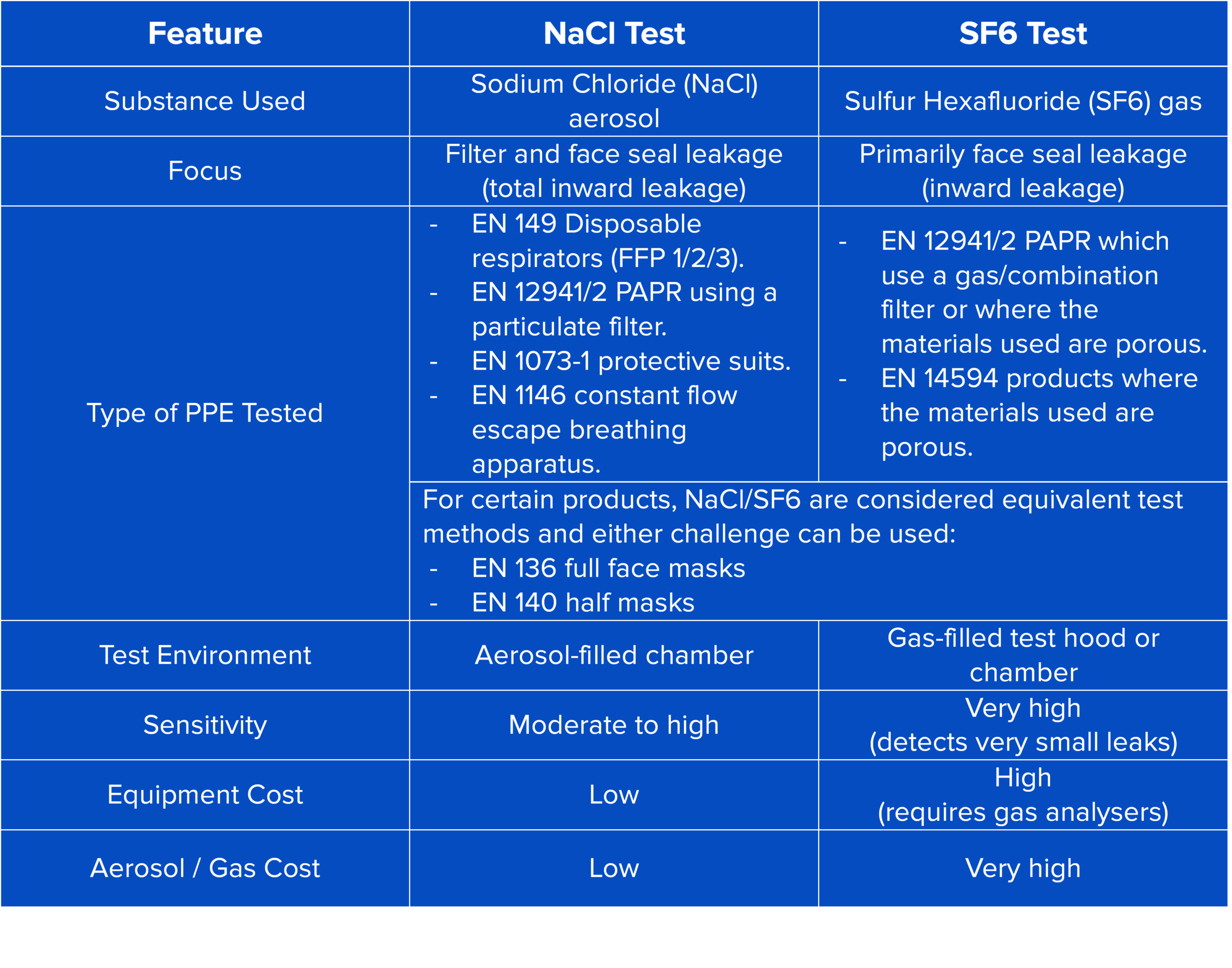
The difference between NaCl and SF6 inward leakage testing lies in the test method, purpose, sensitivity, and the type of respiratory protection equipment being evaluated. These tests assess how well a mask or respirator seals against the face and prevents contaminated air from leaking in, but they are used in different standards and contexts.
NaCl (Sodium Chloride) Inward Leakage Testing
What is it? A test using a fine Sodium Chloride (NaCl) aerosol to measure total inward leakage (TIL) through the face seal and filter (and any connections in between!).
Purpose: To assess the (as close to real-world) performance of respirators including both:
- Filter penetration, and
- Face seal leakage
Typical use: EN 149: European standard for filtering facepiece respirators (however, lots of other type of respirator also use this method).
Procedure Summary:
- NaCl aerosol is introduced into a test chamber.
- Test subject performs a set of movements (walking, head turning, talking).
- Aerosol concentration outside vs. inside the mask is measured.
- Reported as a percentage of total inward leakage.
Advantages: Simple principle, cheap materials (uses common salt!), and used widely for testing respiratory equipment. Reflects combined effects of filter efficiency and face fit.
SF6 (Sulfur Hexafluoride) Inward Leakage Testing
What is it? A tracer gas test using Sulfur Hexafluoride (SF6) – a heavy, inert, and highly detectable gas – to measure how much contaminated air leaks into a respirator.
Purpose: To measure face seal leakage, primarily – usually for tight-fitting full-face or half-mask respirators, particularly reusable respirators. Recently introduced for Powered respirators that are designed to protect against gases and vapours. Sometimes used for powered respirator hoods if the hood material is deemed porous.
Typical use: EN 136: European standard for full-face masks. EN 12942 / 12941: Powered respirators, particularly gas and vapour devices. EN 14594: Compressed air fed hoods that are porous.
Procedure Summary:
- SF6 gas is introduced around the wearer in a test hood or chamber.
- Test subject performs a set of movements (walking, head turning, talking).
- A sensitive detector (e.g., photoacoustic, negative ion capture or infrared analyser) measures gas inside the mask.
- Focus is solely on leakage through the face seal (and valves or connections), not filter penetration (as SF6 is very difficult to filter). Reported as a percentage of inward leakage.
Advantages: Highly sensitive and accurate. Can isolate face seal performance. Good for reusable masks and powered systems.