
Complete pre-production samples may be suitable for PPE approval testing, but early development prototypes should not be assumed suitable for formal type-examination. The key requirement is that samples represent the complete product you intend to manufacture and sell.
Manufacturers do not necessarily need to begin full-scale production before applying for EU type-examination. However, the samples submitted must represent intended production and match the technical documentation.
This distinction matters when planning a testing programme, particularly if materials, components or manufacturing methods are still changing.
What does the PPE Regulation require for type-examination samples?
Annex V, paragraph 2 of Regulation (EU) 2016/425 requires examination of:
“a specimen, representative of the production envisaged, of the complete PPE (production type)”
Annex V, paragraph 4(d) also requires the Notified Body to verify that samples have been:
“manufactured in conformity with the technical documentation”
The wording focuses on complete PPE that represents intended production. It does not expressly require samples to come from an established mass-production run.
A complete pre-production sample may therefore be suitable, subject to the Notified Body’s assessment of its representativeness.
What is the difference between a development prototype and a pre-production sample?
The word “prototype” can describe products at very different stages of development. For testing purposes, it helps to distinguish between two situations.
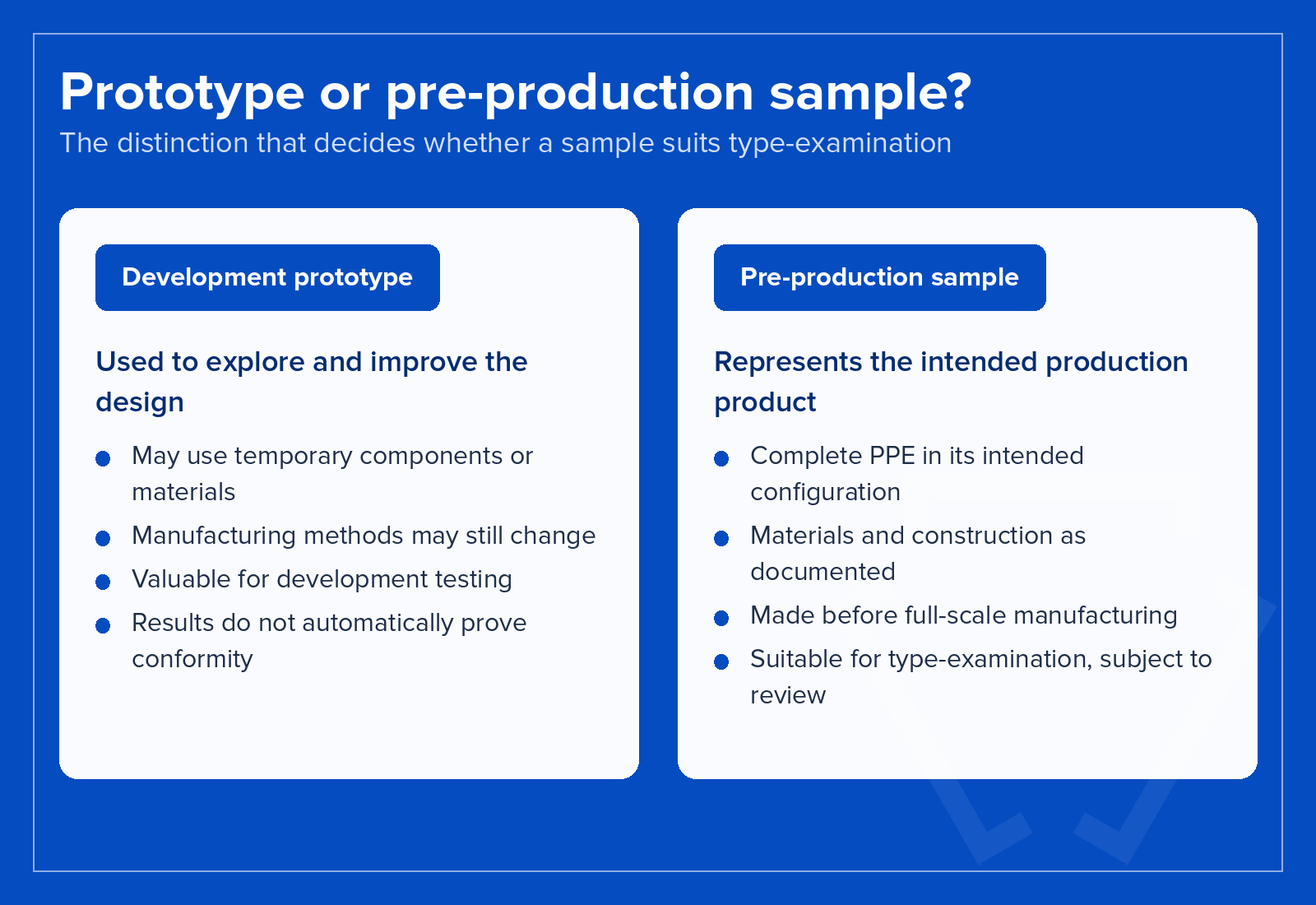
Development prototypes are used to investigate designs, compare materials, assess performance and identify weaknesses. They may include temporary components, alternative materials or manufacturing methods that will change before production. These samples can be valuable for development testing. However, their results should not automatically be treated as evidence of conformity for the final product.
Complete, production-representative pre-production samples may be made before full-scale manufacturing begins, while still representing the intended production product. For formal type-examination, the important question is whether the sample genuinely represents the documented product that will be manufactured and sold.
Our practical recommendation is to review the completeness of the product and its intended configuration; materials, components and construction; manufacturing methods that could influence performance; consistency between the samples and the technical documentation; and any differences between the submitted samples and intended production. Agree sample suitability with the chosen Notified Body before commissioning testing intended to support certification.
Can manufacturing differences affect PPE test results?
Yes. A sample can look and function like the intended production product while behaving differently under test.
For example, a 3D-printed housing may differ from an injection-moulded housing in strength, heat resistance or other properties. Differences in joining methods, seals, coatings or material processing may also influence performance.
The significance of a difference depends on the product and the requirements being assessed. Manufacturers should disclose differences rather than assume that similar appearance or function establishes equivalence.
Passing a test on a development sample does not automatically demonstrate that the final production version will meet the same requirement.
Can prototype test reports be used for certification?
Development test reports can provide useful information, but their suitability as certification evidence depends on the samples tested, the methods used and their relevance to the final design.
Do not assume that every development test must be repeated, or that every result can be carried forward.
Discuss the reports with your Notified Body so it can determine what evidence is acceptable and whether further testing is needed.
What happens if the product changes after type-examination?
Production PPE must conform to the approved type.
Changes affecting conformity with the applicable essential health and safety requirements, or the certificate’s validity, require notification to the Notified Body and additional approval. Further testing may be necessary.
For Category III PPE, including respiratory protective equipment, EU type-examination is followed by one of two modules:
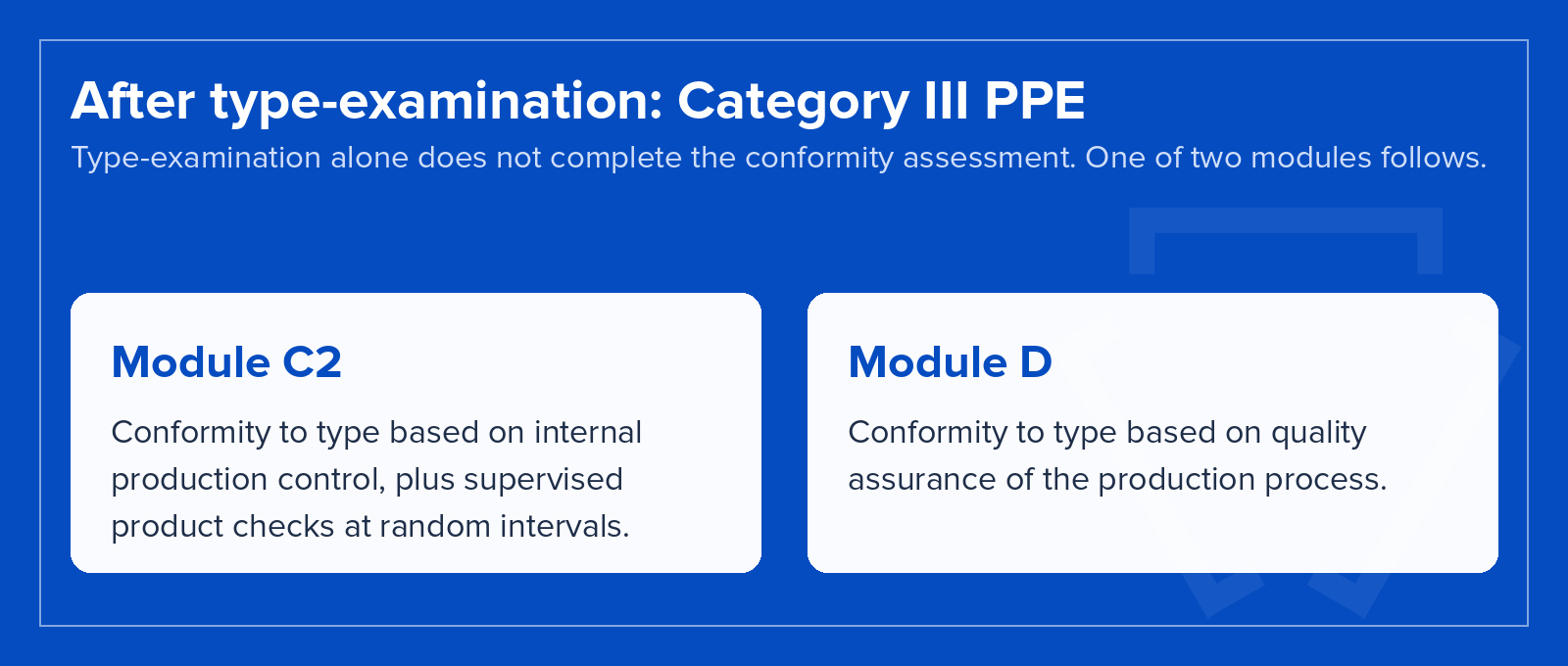
These procedures address continued conformity of production. A type-examination certificate alone does not complete the Category III conformity assessment process.
When should manufacturers start PPE testing?
Development testing can begin while the design is evolving. It can help identify weaknesses before manufacturers commit to tooling, production or a formal certification programme.
For testing intended to support type-examination, we recommend using complete samples that represent the intended production product, with any differences agreed with the certification body beforehand.
A clear testing plan should identify which work supports development and which work is intended to provide certification evidence.
Discuss your RPE testing programme with GCS
Global Compliance Services specialises in respiratory protective equipment testing. Whether you are evaluating an early design or preparing production-representative samples for formal testing, we can help you plan a testing programme around your product’s development stage and certification objectives.
Get in touch to discuss your samples, testing requirements and next steps, or email the team at laboratory@global-compliance-services.com.
Regulatory references: Regulation (EU) 2016/425, Annex V, paragraphs 2, 4(d) and 7.2; Article 19(c); Annexes VII and VIII. The regulation is available from EUR-Lex.